Marque
An entire agency. One connected workspace.
Clients, projects, tasks, time and finance brought together around the way an agency actually delivers work.
Build something like this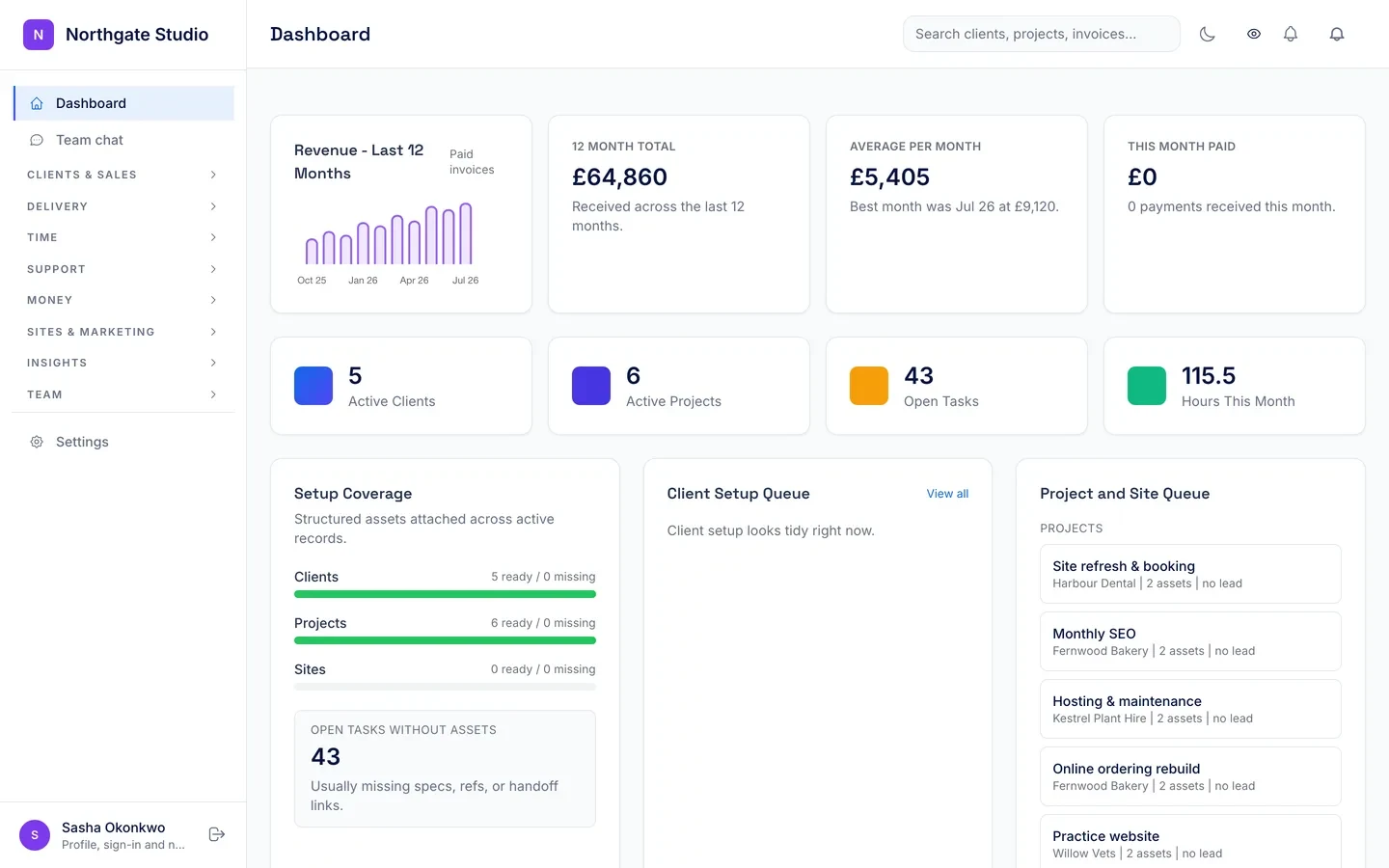 Real product screen with demo data. Figures shown are illustrative, not project results.
A business problem
worth solving.
An agency’s work crosses more boundaries than a project board can capture. A brief becomes a project, tasks consume time, delivery creates invoices, and the relationship continues through support. When each part lives in a separate tool, the team has to reconstruct the story by hand. Marque brings those records into one connected operating model.
The connected solution.
A web-agency CRM covering client records, project delivery, task boards, time tracking, invoices, expenses, reporting and workflow automation. The product connects the commercial relationship to the work being delivered, rather than treating project management and finance as unrelated activities.
The decisions behind
the experience.
The central design decision is the relationship between records: projects belong to clients, tasks belong to projects, and time and financial records remain connected to the work. That structure gives the interface a shared context. A mobile-ready REST API exposes the core platform, while roles, activity logging and two-factor authentication support controlled access.
Following the work, not just listing features.
The product model follows an agency’s delivery chain: client, project, task, time entry, document and ongoing support. Those relationships matter because the same work appears in several contexts. A project needs delivery status, the team needs actionable tasks, and finance needs records that can be traced back to the client. The specification therefore has to account for shared context as well as individual screens.
The interface has a documented token and component layer for colours, spacing, controls, validation and accessibility. Agency branding can change without changing the meaning of a warning or a destructive action. Labelled inputs, connected error messages and keyboard-operable controls make these behaviours reusable rather than depending on each screen getting them right independently.
The same work should produce the same numbers.
Quotes and invoices share a central document-totals calculation. The calculation rounds monetary values to two decimal places, constrains the discount to the available subtotal, calculates tax on the discounted amount and prevents an accidental negative total. It also handles line items with different tax rates by grouping them and distributing a document discount proportionally.
The final group receives any rounding remainder so the full discount is accounted for. A related allocation method distributes those group discounts back across the lines. That is a concrete example of engineering beyond the visible interface: keeping documents and their component values consistent when the user changes the shape of the work.
Access, arithmetic and interface behaviour.
The engineering includes tenant boundaries, expiring tokens, document arithmetic and per-agency records. The design-system documentation also identifies behavioural tests for field error wiring and error-page rendering. These are targeted checks of the things users depend on: whether a field explains its error, a document adds up consistently, and a record stays in the correct agency context.
The shared calculation and component layers give future work a consistent foundation. New document workflows can reuse the same arithmetic; new controls can reuse the same labels, feedback and keyboard behaviour. That reduces the number of places where the same business rule has to be maintained.
Where the detail matters.
Delivery workspace
Client-linked projects, task boards, status and budget tracking give teams a shared view of the work.
Time into finance
Live timers, manual time entries, approval workflows, invoice line items and expenses connect effort with billing.
Connected workflows
Trigger, condition and action rules support email and Slack automation. Reporting brings together revenue, utilisation and profitability.
The experience behind the interface.
Binary Beach, part of TGF Digital, explores this build through its user journeys and product-design decisions.
Read the product experience study ↗Capability you can
put to work.
Shows how we turn a complex service workflow into a cohesive product: data modelling, operational UX, role-based access, finance workflows and API development.
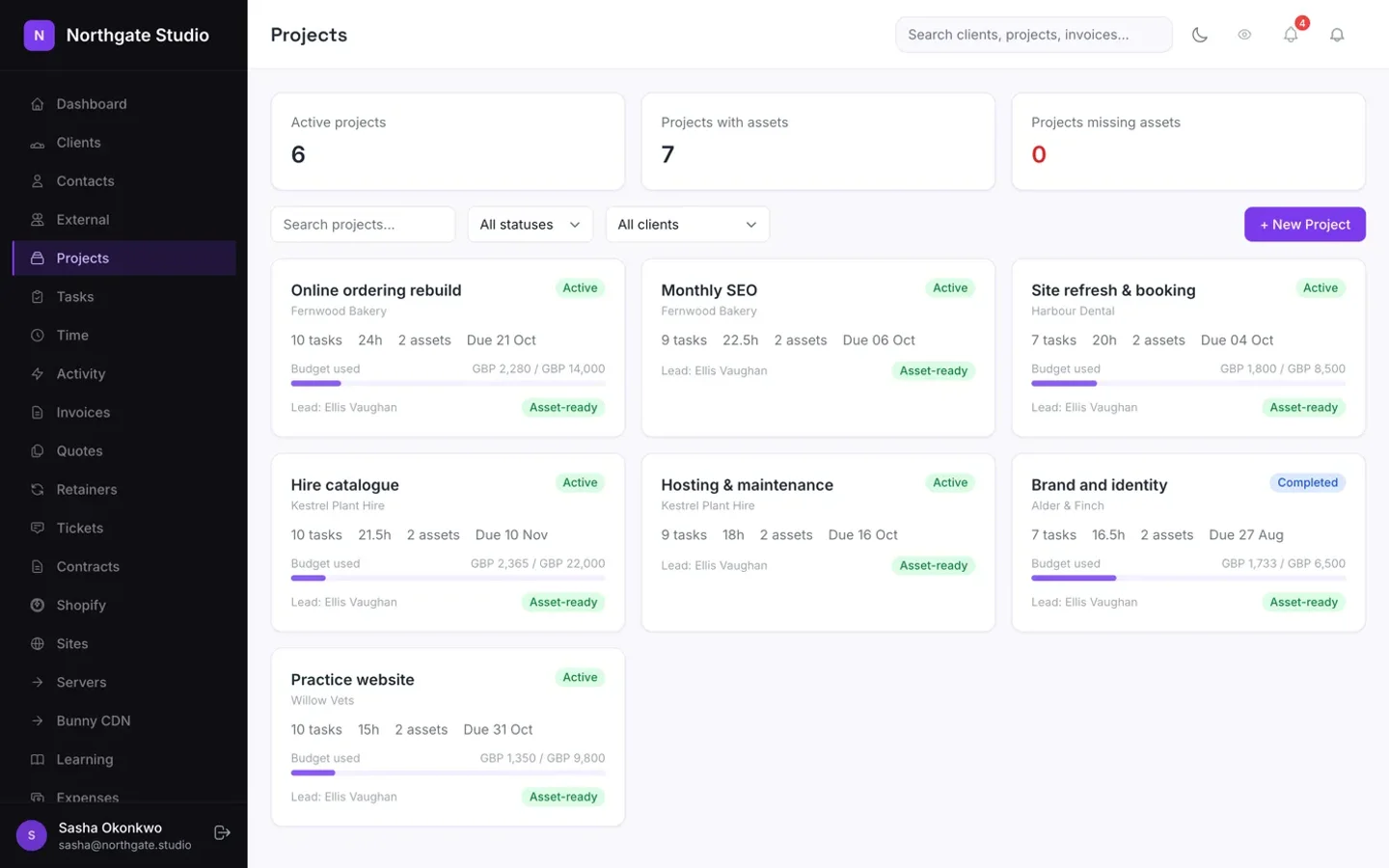
Another view of the product, using demo data.
Similar challenge?
Let’s make your version.
A CRM, client portal or operating system built around your own business.
Discuss your project Explore the other builds